

Choosing a pet usually means thinking beyond the first impression. A rabbit that needs more space than expected, a bird that cannot live happily alone, or a dog whose energy level does not match the household can all become difficult fits when the decision is based on appearance alone. Fish deserve the same kind of planning, even though pet buyers are often encouraged to think of them as simple add-ons.
That mindset causes problems fast in aquariums. One of the easiest ways to make a community tank harder than it needs to be is to choose fish one at a time without checking how they fit together. In fishkeeping, a community tank simply means an aquarium where multiple species share the same space. A species can look peaceful in the store, seem small enough for the tank, and still turn into a problem once it is placed with the wrong tankmates.
That usually happens because compatibility is broader than aggression alone. Fish can be incompatible because they need different water conditions, different group sizes, different swimming space, different flow, or simply a different kind of environment. Even two “peaceful” fish can stress each other if one is hyperactive and the other needs calm water and quiet territory.
The good news is that most stocking mistakes can be reduced before money changes hands. In aquarium terms, stocking means the overall mix and number of fish kept in the tank. Instead of asking, “Can these fish live together?” as a vague yes-or-no question, it helps to run through a short set of checks that covers behavior, size, tank footprint, social needs, and overall stocking pressure.
This guide walks through that process in practical terms so a general pet reader or aquarium hobbyist can make better decisions before bringing new fish home.
Start With the Tank, Not the Fish
Many compatibility problems begin before species research even starts. The tank itself sets the limits. That means capacity, layout, dimensions, filtration, and the fish already living there all matter before a new addition is considered. Filtration is simply the system that moves and cleans the water, and its strength affects how stable the environment stays.
If a tank is already near its practical limit, even a fish that is technically peaceful may tip the system into chronic stress. More competition for space, oxygen, cover, and food can make behavior worse across the board.
That is why compatibility should never be separated from stocking level. Before comparing personalities, it helps to estimate whether the aquarium can realistically handle the total plan at adult size. A tool such as Guidarium’s freshwater aquarium stocking calculator can be useful here because it forces the hobbyist to think in terms of the whole tank, not just the next purchase.
This does not replace observation or research, but it does solve a common blind spot: a fish can be compatible on paper and still be a bad fit for a tank that is already crowded.
Check Adult Size, Not Store Size
One of the most common mistakes in aquarium shopping is making decisions based on how fish look in a sales tank. Juveniles distort judgment. Small fish seem harmless, slow, and easy to fit, but their adult size changes everything from territory to waste production to the amount of swimming room they need.
How large will each fish get?
A three-inch fish and a six-inch fish do not use space the same way, even if both are labeled peaceful. Adult size affects:
- How much waste the fish produces
- How much room it needs to turn and patrol
- Whether it can intimidate or eat smaller tankmates
- Whether it becomes dominant around feeding time
How fast will it get there?
Growth rate matters because a tank can look stable for months before problems appear. A new fish that seems to “fit” today may quickly become the largest, boldest, or messiest fish in the aquarium.
Will its size change its behavior?
Some species are manageable when young and much pushier when mature. Others become territorial once they pair off or claim breeding sites. Compatibility should be judged at the point the fish is expected to reach, not at the point it is sold.
Temperament Is More Than “Aggressive” or “Peaceful”
Retail labels often oversimplify behavior. In practice, temperament exists on a spectrum. A fish may be peaceful with similarly sized tankmates, nippy with long-finned species, shy in open tanks, or aggressive only when crowded.
That is why simple category labels are not enough. When comparing species, it helps to ask more specific questions.
Is the fish territorial?
Territorial fish often need floor space, hiding places, or visual barriers. They may not chase every tankmate, but they can still make part of the tank unusable for others.
This is especially important with:
- Bottom dwellers
- Cichlids
- Cave spawners
- Fish that defend driftwood, rockwork, or planted corners
Is the fish fin-nippy?
Some species are not truly aggressive, but they are a poor match for slow or long-finned fish. A community tank can unravel quickly when repeated fin picking stresses a calmer species.
Is the fish easily intimidated?
Compatibility is not only about whether a fish bullies others. It is also about whether it gets bullied without obvious physical damage. A timid fish that hides all day, skips meals, or refuses to leave cover is not in a compatible setup, even if no one is being visibly attacked.
Is the fish calm or constantly active?
Activity level is often overlooked. Fast, restless schooling fish can unsettle species that prefer quiet, structured territory. On the other hand, a sluggish fish may lose every feeding competition in a tank full of fast movers.
Compare Water Parameters Before Anything Goes in the Bag
A fish may tolerate a wide range in captivity, but that does not mean every overlap is a good match. Compatibility works best when species share a comfortable range, not just a technical minimum and maximum.
The key parameters to compare are:
Temperature
If one species thrives in cooler water and another needs consistently warmer conditions, one of them will be compromised. That may not cause immediate death, but it can increase long-term stress and disease risk.
pH and hardness
These do not need to match perfectly for every community tank, but major mismatches should be treated as a warning sign. pH measures how acidic or alkaline the water is, while hardness refers to the amount of dissolved minerals in it. Fish adapted to soft, acidic water are not automatically good companions for species that prefer hard, alkaline conditions.
Flow and oxygen demand
Some fish enjoy strong current and high oxygen. Others prefer slower, gentler water. This matters because filtration and circulation affect the entire tank. Creating a suitable environment for one type of fish can make another constantly uncomfortable.
If the tank setup has to be a compromise, the question becomes whether both species can genuinely do well in that middle ground, not merely survive it.
Think in Terms of Tank Zones
One reason some community tanks work better than expected is that the fish occupy different parts of the aquarium. Another reason some tanks fail is that too many species want the same zone. Tank zones simply means the areas fish prefer to occupy, whether near the surface, in the middle, or along the bottom.
Before buying, identify where each fish spends most of its time:
- Top level
- Midwater
- Bottom
- Hardscape and caves
- Plant cover and edges
This does not guarantee success, but it helps reduce direct conflict. A tank with one midwater school, one bottom group, and one calm centerpiece species often works more smoothly than a tank where every fish wants the same open center lane or the same cave system.
Zone overlap matters most when the species involved are territorial, shy, or dependent on structure.
Do Not Ignore Social Needs
Some fish are sold singly even though they are not meant to be kept alone. Others are bought in groups even though they become combative in crowded numbers. Both mistakes can look like compatibility issues when the real problem is social structure.
Schooling and shoaling species
Many tetras, rasboras, danios, and corydoras do better in proper groups. Kept in undersized numbers, they may become skittish, nippy, or withdrawn. A hobbyist may blame the wrong tankmate when the actual issue is that the fish never felt secure. Schooling or shoaling species are fish that rely on being with their own kind to feel safe and behave normally.
Pairing and breeding behavior
Some otherwise manageable fish become more defensive when paired. A species that seems fine as a single juvenile may behave very differently as an adult pair guarding a site.
Solitary species
Certain fish do better with space and fewer direct competitors. Adding too many fish with similar behavior can create stress even if each species is considered community-safe on its own.
A good compatibility check always includes the number of fish being purchased, not just the species name.
Ask Whether the Fish Can Compete for Food
Feeding behavior can quietly decide whether a tankmate combination works. A fish that gets outcompeted every day may decline long before obvious aggression appears.
How fast does it feed?
Quick, bold fish often dominate floating or midwater foods. Slower species may need target feeding, sinking foods, or a calmer setup.
What does it prefer to eat?
A bottom grazer, micro-predator, algae browser, and omnivorous scavenger do not all feed the same way. If the tank routine cannot accommodate those differences, one species may slowly lose condition. A bottom grazer feeds mostly along the substrate, the material covering the tank floor, while a micro-predator hunts tiny live foods or similarly small prey items.
Does it feed at the same time as everything else?
Nocturnal or shy fish may struggle in brightly lit, high-activity tanks unless the keeper is intentional about feeding strategy.
Food competition is easy to underestimate because a fish can still appear interested at feeding time while getting a smaller share than it needs.
Look at Shape and Mouth Size
Predation risk is not limited to obviously predatory fish. In aquariums, a simple rule holds up well: if a fish can fit another fish in its mouth, it may eventually try.
This is not just about large carnivores. It can apply when:
- One species remains very small
- Juveniles are mixed with larger adults
- Long-bodied fish look bigger than they really are
- Sleepy or slow-moving tankmates are present at night
Body shape also matters in the other direction. Slender, delicate fish may be stressed by boisterous, deep-bodied, fast-feeding tankmates even when outright predation is unlikely.
Use a Side-by-Side Compatibility Check
After the broad checks above, it helps to compare the exact species directly. That means looking at both fish, or the new fish against the full stocking list, through the same set of criteria rather than relying on memory or store labels.
A useful fish compatibility guide can help organize that side-by-side check because it keeps attention on the variables that matter most: temperament, adult size, social needs, water range, and likely tank conflict points.
When doing this comparison, try to avoid the trap of focusing only on one green flag. A fish that matches temperature but clashes on territory is still a poor choice. A fish that is peaceful but too active for the rest of the tank is still a poor choice. Compatibility works when the factors align together, not when one of them does.
Watch for Red-Flag Combinations
Some pairings deserve extra caution even when individual species are often sold as community fish.
Long-finned fish with known nippers
This is a classic mistake. A peaceful centerpiece fish can become a constant target if its finnage attracts attention.
Slow fish with frantic schooling fish
A fish may not be attacked, but it may never settle. Chronic motion around a calm species can be enough to suppress normal behavior.
Bottom dwellers with too little floor space
Multiple bottom species are often combined because they seem “out of the way.” In reality, the substrate level is limited real estate. Territorial disputes often happen there first. Bottom dwellers are species that spend most of their time near the floor of the aquarium rather than in open water.
Tiny community fish with fish that become opportunistic
Even semi-peaceful larger fish may eat very small tankmates once they mature.
Species with conflicting environment needs
A fish that prefers heavy planting, dim cover, and calm water is not automatically a good fit with species that want open swimming lanes and stronger flow.
These combinations are not impossible in every case, but they are exactly the kinds of setups that deserve slower, more skeptical decision-making.
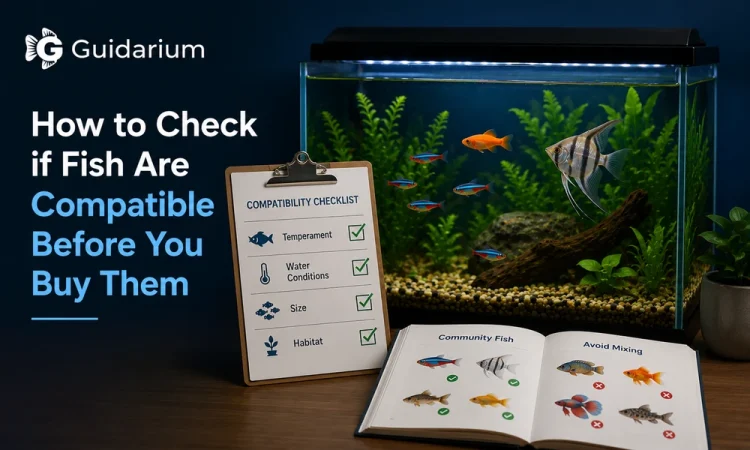
A Simple Pre-Purchase Compatibility Checklist
1. What is the fish’s real adult size?
Do not use the store size as the reference point.
2. What is its normal temperament?
Not just “peaceful” or “aggressive,” but territorial, nippy, shy, active, or bold.
3. What water range does it genuinely prefer?
Look for comfortable overlap, not extreme tolerance.
4. What part of the tank does it use most?
Check whether that space is already crowded.
5. Does it need a group, a pair, or isolation?
Make sure the social requirement fits the tank.
6. Can the aquarium support the full adult stocking load?
Think beyond the next fish and look at the whole system.
7. Can it eat and live without being stressed by current tankmates?
Compatibility includes feeding success and day-to-day confidence.
8. Is there any realistic chance it will bully, be bullied, or eat something smaller?
If the answer is “maybe,” slow down and research more.
That checklist takes only a few minutes, and it is usually enough to prevent the most expensive mistakes.
In the Store, Slow the Decision Down
Impulse buying causes a large share of compatibility problems. A fish seen under bright lighting in a sales tank often looks easier to fit than it really is.
A better approach is to pause and ask:
- Is this fish being sold as a juvenile?
- Is it being kept temporarily in a bare retail setup that does not reflect its real adult behavior?
- Am I choosing it because it fits the tank, or because it looks good today?
- Do I know how many of them should be kept?
- Do I know what existing fish in my tank may react badly?
If any of those answers are unclear, the safest move is to wait.
Aquarium stores will always have another fish. A stable tank is harder to rebuild once a poor match has been introduced.
Compatibility Is About Long-Term Stability
A new fish does not need to cause immediate fighting to be a bad addition. Many mismatches unfold slowly. Fin damage appears later. Feeding imbalance becomes visible later. Territorial pressure gets worse as fish mature. Water quality becomes less forgiving as bioload rises. Bioload is the amount of waste the fish population puts into the system, which directly affects how hard the tank has to work to stay clean and stable.
That is why the right question is not, “Will they survive together this week?” It is, “Can this tank stay stable and low-stress over time if these fish all reach adult size?”
That change in perspective helps hobbyists avoid the most common trap in stocking decisions: judging success too early.
FAQ
Can peaceful fish still be incompatible?
Yes. Fish can be incompatible because of size difference, activity level, feeding style, territory needs, group requirements, or water preferences even when neither species is especially aggressive.
Is matching temperature enough to call fish compatible?
No. Temperature overlap is only one factor. A sound compatibility decision also checks adult size, behavior, tank zone, social needs, and overall stocking pressure.
Should I trust store labels that say “community fish”?
Treat that label as a starting point, not a final answer. Many community fish still have specific limits that matter in real aquariums.
Is it safer to add only one fish at a time?
Sometimes, but not always. Species that need a proper group should usually be planned and purchased accordingly. The key is not just the number added at once, but whether the final setup makes sense.
Final Thought
Checking fish compatibility before buying is less about finding a universal yes-or-no answer and more about ruling out obvious problems before they enter the tank. If the adult size works, the temperament lines up, the water needs overlap, the social structure makes sense, and the aquarium can support the full plan, the odds of a stable community tank improve sharply.
That process is not complicated, but it does require discipline. A few extra minutes of research before purchase is usually much easier than trying to fix stress, aggression, or overstocking after the fact.